Duplex Residence Design at Narayanganj
Client:
Robin Ahmed
Project Type:
Residential Interior + Landscape Integration
Location:
Boktaboli, Narayanganj
Status:
Under Construction
Area:
2,183 sq.ft
Project Overview:
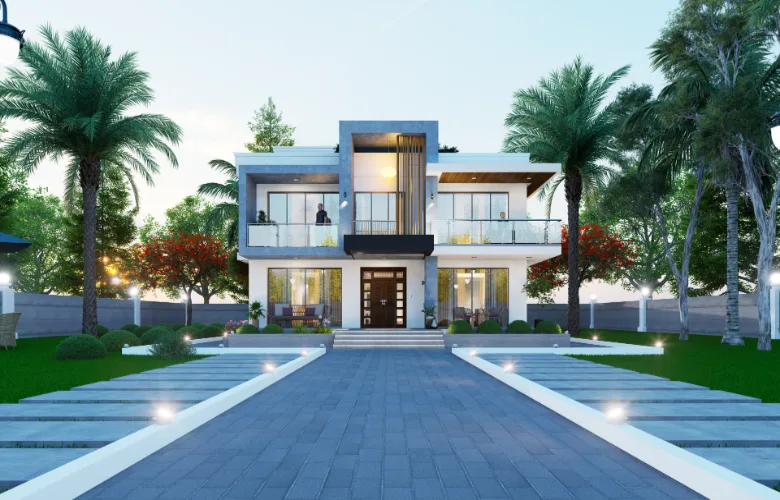
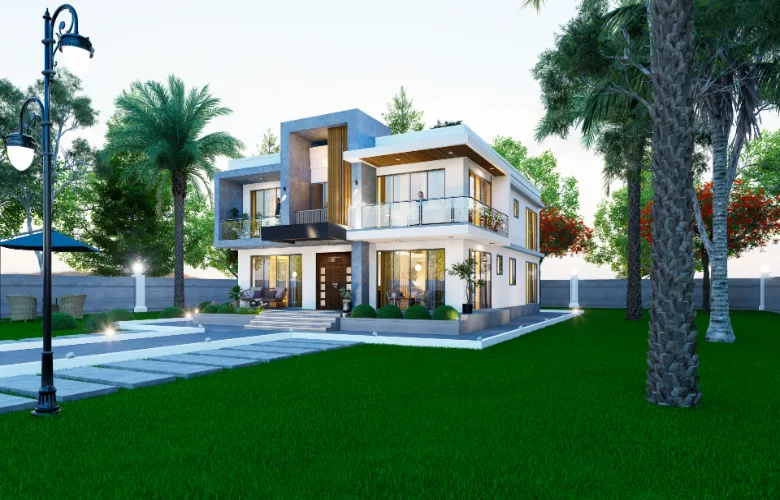
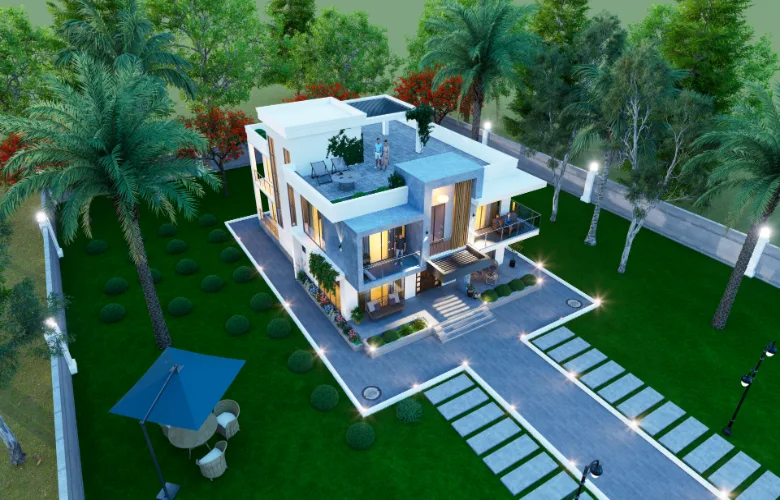
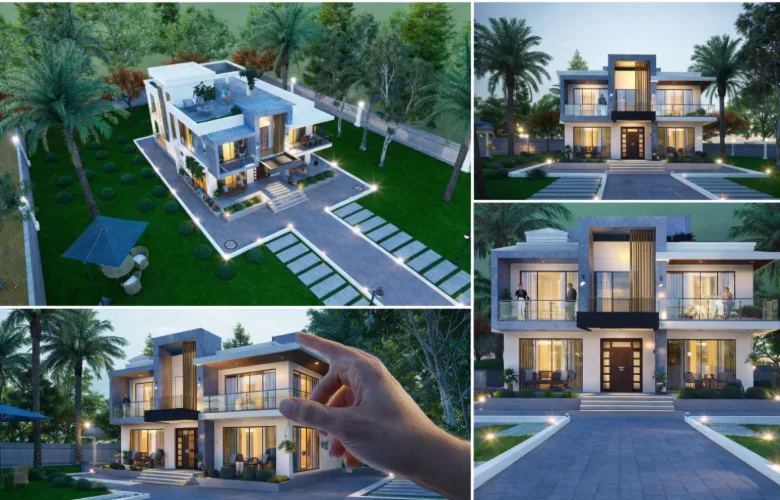
This contemporary residential interior-led home for client Robin Ahmed, measures 2,183 sq. ft., is currently under construction in Boktaboli, Narayanganj, and will be a dwelling place for a modern upper-middle class family which has been searching for a balance between being aesthetically pleasing, yet comfortable for their daily lives. The building’s architecture seeks to expand upon the idea of living space beyond simply encloseable rooms by incorporating garden spaces, terraces, and rooftop spaces. The essence of this building lies in its ability to seamlessly move between indoor living spaces and the landscaped, resort-like outdoor environment.
Project Story:
The project initiated from a very basic but challenging requirement; a home that would feel open and connected to the natural world while at the same time providing the necessary privacy for a multiple-zone family lifestyle. The client had a vision of creating a residence where all aspects of daily routine along with the various social events and gatherings could occur simultaneously without conflicting with each other spatially.
In order to achieve this goal instead of using enclosed rooms as the primary means to divide up spaces within the home, the designers used both the land and architectural layers as the major structuring tools. On the lower levels of the home there are social areas that are open directly toward the garden so that residents may have easy access to garden seating areas. Conversely, higher levels of the home become increasingly private with controlled environments such as those found on the balconies serving as buffer areas to help control exposure to sunlight.
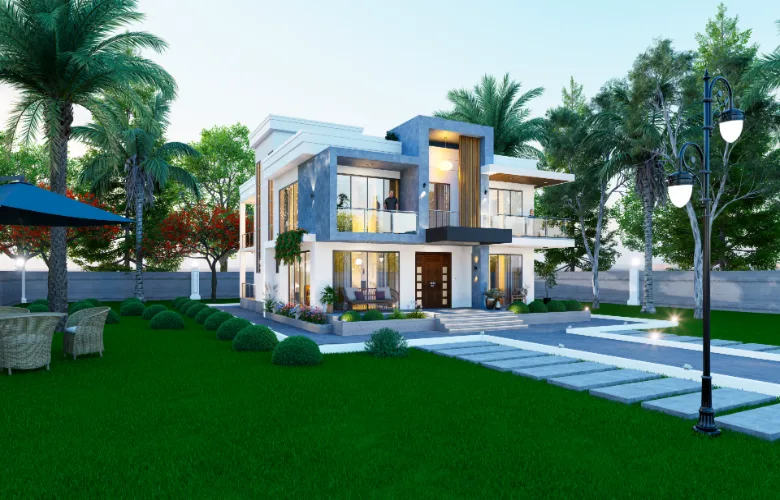
Another significant design choice made by the designers was treating the outdoor environment as an expansion of the interior program. Umbrella shaded seating areas, pathway lighting and small landscaped pocket areas were viewed not merely as secondary features but rather they defined how the residents of this home would experience it throughout the day.
Ultimately what resulted was a calm, modern tropical residence where architecture and nature operated as a singular unit or system versus two distinct entities.
Project Insights:
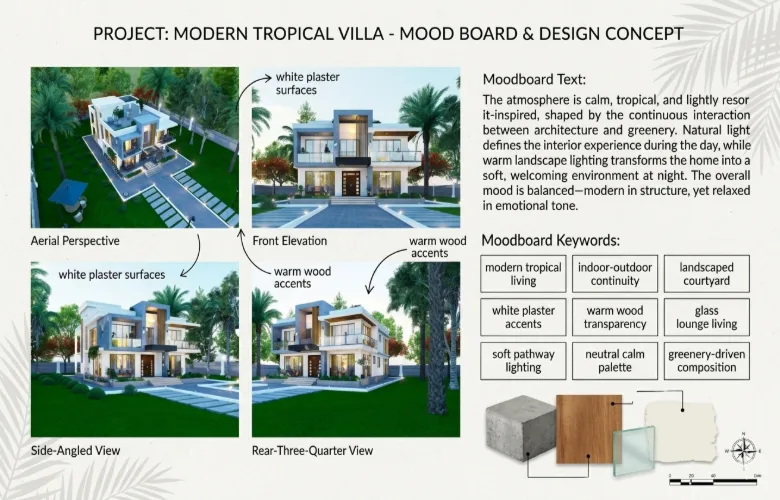
- Continuity established between indoors and outdoors through direct visual and physical links to landscape.
- Active social zone on ground floor opens directly onto garden seating area.
- Rooftop serves as an additional recreational/leisure/gathering space.
- Use of balcony position allows balancing of privacy with daylight access.
- Landscaping utilized as a spatial organizer and not just as a decorative foreground.
- Glass railings allow for retention of transparency while maintaining openness/safety.
- Utilization of pathway lighting aids users in circulation and enhances nighttime usability.
- Restraint of material choices enables greenery to become dominant visual element.
- Horizontal lines on façades aid in reinforcing architectural stability/clarity.
- Design responds to climate to support ventilation/heat management.
Design Details:
Space Planning:
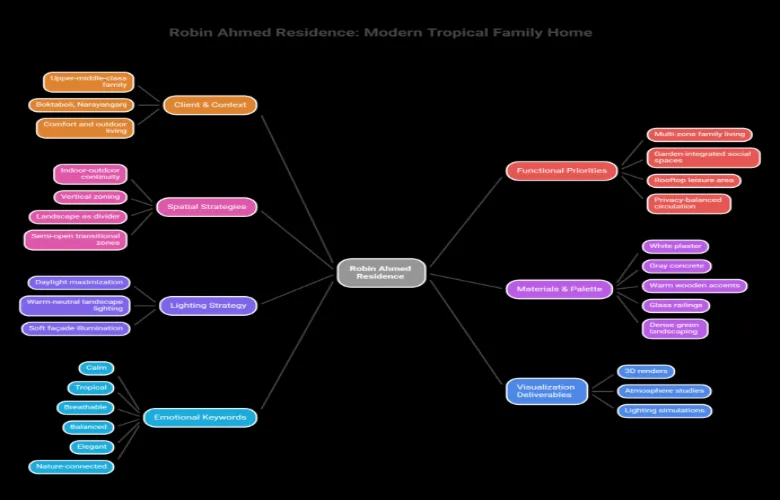
There is a clear vertical zoning in this residence. All social functions are centered on the first level and connect directly to the landscaped outdoor spaces. Private rooms are placed on upper levels with controlled access via balconies. The circulation path is kept simple and straightforward with good visual connection between inside and out.
Materials & Finishes:
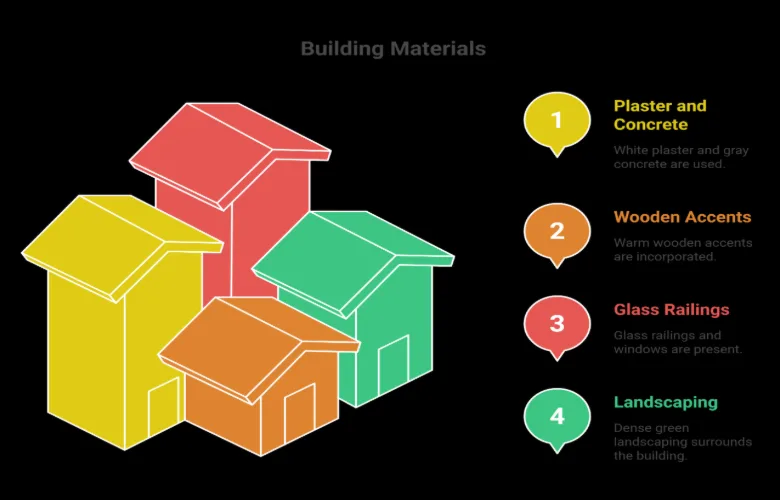
Smooth white plaster, gray concrete texture finishes, warm wood accent finishes, and numerous glass components comprise the material palette. These materials produce a controlled contrast – solid surface components provide structural integrity, while glass and vegetation add lightness/openness to the space.।
Lighting & Atmosphere:
Daylight enters freely through expansive window openings and through translucent balcony systems thus allowing for bright and naturally lit interior spaces. In the evening hours, warm neutral color temperature landscaping lighting and low-intensity facade illumination create a soft and inviting residential ambiance. Nighttime lighting was intentionally designed to enable extended use of outdoor spaces.
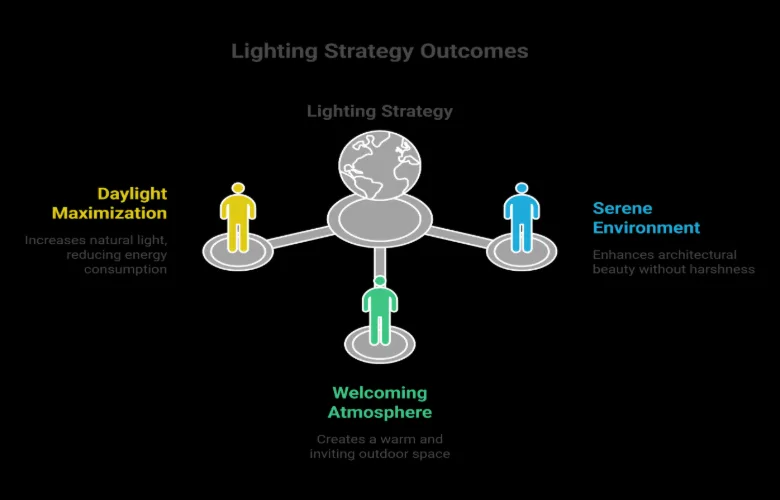
Color & Texture:
An extremely limited palette consisting of white, gray, and wood tones was complemented by rich greenery from the landscaping. Textural variations include matte finish plaster, reflective glass finishes, and organic foliage finishes resulting in a visually layered but serene atmosphere.
Furniture & Joinery (Exterior Interface):
Seating areas located outdoors adjacent to umbrellas covered lounges, and outdoor tables on terraces serve as extensions of the building. These elements are incorporated into the total spatial organization of the building rather than considered separate objects; therefore, maintaining design coherence.
Visualization & Experience:
The project progressed through both interior and exterior three-dimensional renderings including daylight analysis, garden atmospheric renderings, and rooftop experiential simulations. The visualizations assisted the client in understanding functional flow, privacy conditions, and outdoor usability prior to construction commencing. The visualization process greatly assisted in synchronizing lifestyle requirements with architectural realization.
How do you think the designers balanced privacy with an "open" plan?
A: The designers strategically placed plants and used balcony railings so that the views are filtered but the sunlight isn’t blocked.
Is there anything you would like to see changed in order to make the outdoor space usable year-round?
A: There were several elements in the design that allowed it to be comfortably used regardless of weather; these included shaded sitting spaces and a rooftop design.
How was landscaping treated in your opinion (as either decoration or as part of the overall spatial organization)?
A: Landscaping played a crucial role in organizing the physical space of the house. It functioned as a spatial organizer, not simply as decoration.
Do you believe the home feels too exposed/open for a typical family setting?
A: No, I don’t believe that it felt too exposed/open. The designers created vertical zones and limited sightlines between areas of the house to maintain privacy.
How was nighttime ambiance addressed?
A: The designers utilized warm landscape lighting at night to create a soft, resort-like ambiance after the sun had set.
In what way(s) did visualization assist you in understanding the project's goals and/or design decisions?
A: Visualization assisted me in simulating the experience of using the outdoor space and refining my own perception of how people move through a built environment. Visualization also enabled me to better understand how the design would ultimately function prior to its construction.
Could this design philosophy be applied to smaller houses/compact lots?
A:Yes, I believe that this philosophy could be scaled down and applied to smaller houses/compact lots.